
Signs your cortisol is dysregulated
This post contains affiliate links. Friendly reminder that I only share products I personally use and love, and think you would love, too.
Hiiii! How’s the day treating you? I have a couple of meetings this morning and packing because we’re seeing BTS this weekend (the girls are pumped).
For today, let’s talk about energy and cortisol. It’s a huge topic, something I talk about with clients a lot, and something that I struggled with for years.
For a long time, I thought I was just tired because of… life.
I had a full coaching schedule, was creating content, taking care of the girls, the Pilot was often traveling/deployed/working, trying to keep up with workouts, and doing all the things. Of course I was exhausted. Of course I was wired at night and dragging in the morning. That’s just life, right?
I remember going to the doctor when Liv was little (not my current PCP, it was a doctor on base) and she was like, “You have a toddler. Of course you feel horrible.”
It took me longer than I’d like to admit to realize that what I was experiencing wasn’t just a busy-life thing. It was a cortisol thing. And once I actually looked at my cortisol pattern – not just assumed everything was fine because my basic labs came back “normal” – so many things clicked into place.
If you’ve been feeling off and can’t quite put your finger on why, this post is for youuuuuu. We’re going to talk about what cortisol actually does, the signs it’s out of balance, what drives dysregulation in the first place, and what’s genuinely helped me, including the test I wish I’d run years earlier.
Signs Your Cortisol Is Dysregulated (And What to Actually Do About It)
First, What Is Cortisol Actually Doing?
Cortisol gets a bad reputation as the “stress hormone,” but it’s not inherently the enemy. It’s produced by your adrenal glands and plays a critical role in almost every system in your body: energy metabolism, blood sugar regulation, immune function, inflammation response, and your sleep-wake cycle.
In a healthy pattern, cortisol follows a predictable daily rhythm: it peaks in the morning (this is what helps you wake up and feel alert to start the day), gradually declines throughout the day, and reaches its lowest point at night so you can fall and stay asleep. That curve is everything. When it’s working, you feel like yourself: energized when you need to be, able to wind down when it’s time.
When it’s not working? That’s when things get a lil messy.
Cortisol dysregulation doesn’t just mean “too high” or “too low.” It means the pattern is off and there are actually several different ways that can look. You might have high morning cortisol and crash by noon. You might have a flat curve with low cortisol all day. You might have low morning levels and a spike at night (hello, second wind at 10pm that makes no sense but makes you want to redecorate your whole house). Each pattern has different root causes and different solutions, which is exactly why a standard blood test that only checks cortisol at one point in time tells you so little.
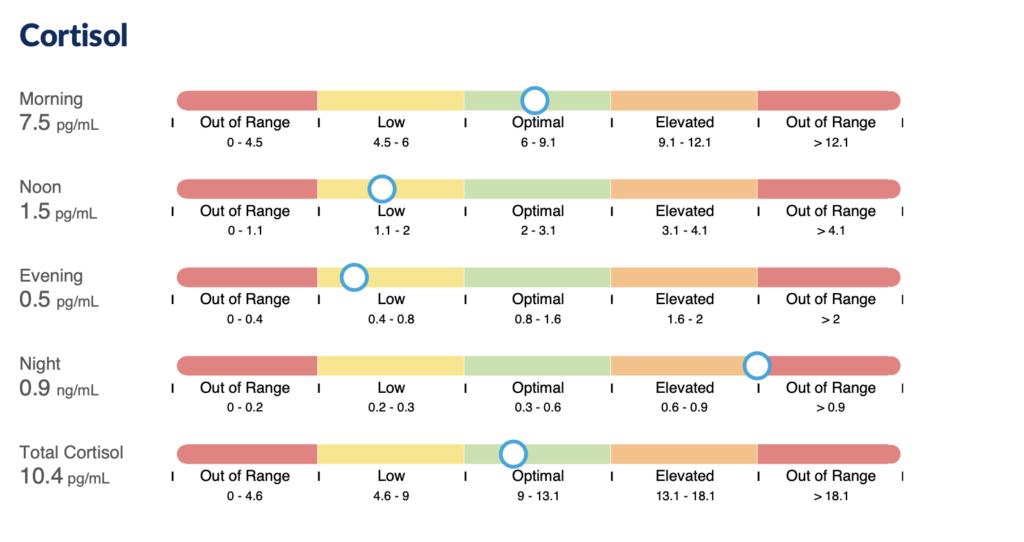
Signs Your Cortisol Pattern May Be Off
These aren’t rare or extreme symptoms. A lot of them sound like everyday life, especially when you’re a busy mom and juggling a billion things, which is part of why cortisol dysregulation goes unaddressed for so long.
You’re exhausted in the morning no matter how much you slept. If you wake up unrefreshed, need multiple alarms, or feel like you could go right back to sleep after 8 hours, low morning cortisol may be part of the picture. Cortisol is supposed to rise sharply in the first 30–45 minutes after waking (this is called the cortisol awakening response). When it doesn’t, mornings feel BRUTAL. (I think this is why I hated the morning for so long lol.)
You get a “second wind” late at night. You’re dragging all evening, then suddenly feel awake and alert around 9 or 10pm when you should be winding down. This is often a sign of elevated cortisol at night; the opposite of where it should be on the curve.
You crash in the afternoon. The 2–3pm energy dip affects a lot of people, but if it’s consistently debilitating – like you genuinely cannot function without caffeine, a boatload of sugar, or a nap – it’s worth looking at what your cortisol is doing mid-day.
You feel anxious for no clear reason. Elevated cortisol, especially in a dysregulated pattern, can show up as low-grade anxiety, a feeling of being “on edge,” or an inability to feel calm even when nothing is actively wrong.
Your sleep is light, fragmented, or you wake between 2–4am. Cortisol and melatonin work in opposition — when cortisol rises at night, it suppresses melatonin. Night wakings, especially in the early morning hours, are a classic sign of cortisol dysregulation. (Note that it can be other things, too, like liver/detox, blood sugar imbalance, poor sleep hygeine, parasites, hormones, etc.)
You hold weight around your midsection despite eating well and exercising. Chronically elevated cortisol signals the body to store fat, particularly visceral fat in the abdominal area. If you’re doing everything “right” and still struggling with this, cortisol is worth investigating.
Your hunger and cravings feel out of control. Cortisol raises blood sugar (it’s preparing you to fight or flee), and when blood sugar swings happen repeatedly throughout the day, cravings go wiiiiiild.
You feel “tired but wired.” This one is so common and so uncomfortable. You’re exhausted, but you can’t relax. You can’t turn your brain off. You feel depleted but somehow still keyed up. This is often a sign of high cortisol at the wrong times of day.
You’re getting sick more often. Cortisol has a complex relationship with immune function. Short-term, it’s anti-inflammatory. But chronically elevated or chronically low cortisol both compromise immune resilience over time.
Your cycle is irregular, or your PMS has gotten worse. Cortisol and sex hormones share the same precursors. When your body is under prolonged stress, it prioritizes cortisol production, sometimes at the expense of progesterone. This is sometimes called “progesterone steal” and it can show up as shorter luteal phases, worse PMS, irregular cycles, and more.

What Causes Cortisol to Get Out of Balance?
This is where I want to be really honest: most of us are doing multiple things that dysregulate cortisol without realizing it.
Chronic stress (obvious, but worth a mention). Your nervous system doesn’t differentiate between a work deadline, a difficult relationship, a scary news cycle, or a near-miss in traffic. Prolonged activation of the stress response keeps cortisol elevated over time, and eventually the adrenals struggle to keep up.
Poor sleep. Cortisol and sleep have a bidirectional relationship – poor sleep disrupts your cortisol rhythm, and dysregulated cortisol disrupts your sleep. Once you’re in this loop, it compounds quickly.
Blood sugar swings. Every time your blood sugar drops, your body uses cortisol to bring it back up. Eating lots of refined carbs, skipping meals, or going too long without eating creates a blood sugar rollercoaster that keeps cortisol in constant demand.
Over-exercising or under-recovering. Exercise is a stressor (a beneficial one!), but high-intensity training without adequate recovery raises cortisol. If you’re doing back-to-back hard workouts, not sleeping enough, and not eating enough protein, your cortisol is working overtime.
Caffeine timing and quantity. Caffeine spikes cortisol. Having coffee first thing in the morning when cortisol is naturally peaking can amplify the curve in ways that make the afternoon crash worse. This was one I’ve had to work on personally, and I ended up cutting out caffeine entirely. (I drink mold-free decaf coffee instead!)
Gut and inflammatory issues. Anything that creates systemic inflammation – gut dysbiosis, food sensitivities, chronic infections – activates the stress response and keeps cortisol elevated.
Emotional and relational stress. This one is easy to minimize because it doesn’t feel “physical,” but unresolved stress, grief, caretaking without support, and difficult relationships are real adrenal loads.
How I Actually Found Out What My Cortisol Was Doing
Here’s where I’ll tell you what I wish I’d done sooner: I ran a test that actually looked at my cortisol throughout the day, not just at one point in time.
The test I use and recommend is the EquiLife Women’s Wellness Test – a saliva-based test that measures estrogen, progesterone, and four cortisol markers throughout the day. Saliva testing is ideal for cortisol because it captures the free (bioavailable) cortisol at multiple time points, giving you the actual curve; not a snapshot. Seeing whether your cortisol is high in the morning, crashing by noon, flat all day, or spiking at night completely changes what you do about it. It’s also one of the least expensive functional labs we offer.
What I also love about this particular test is that it pairs the cortisol picture with estrogen and progesterone levels. Because these hormones don’t exist in isolation: they talk to each other, they share resources, and understanding the full hormonal picture is so much more useful than looking at one marker in isolation.
If you want to run this test and go over your results together, I’m offering complimentary results reviews – no coaching fee. You can grab the EquiLife Women’s Wellness Test here and then reach out so I can add you to my client portal (gina@fitnessista.com subject: TEST). I’d love to help you make sense of what you’re looking at.
What’s Actually Helped Me Support My Adrenals
I want to be clear: there’s no single supplement or gadget that fixes a dysregulated cortisol pattern. The foundation is always lifestyle: sleep, blood sugar stability, stress management, movement that matches your current capacity. But once that foundation is in place, there are some tools that have meaningfully moved the needle for me.
EquiLife Adrenal Soothe
This is a supplement formulated specifically for adrenal support, with adaptogenic herbs that help the body modulate its stress response. It’s super calming without making you feel foggy. My evening cortisol used to be high until I added this to my evening routine. You can check it out here.
CBD Gummies
CBD has been one a tool in my routine for supporting a calmer nervous system, particularly in the evenings. I use Cured Nutrition (half a gummy, one to two times a week if I’m feeling stressed or wired) and notice a huge difference when I take them. Look for a brand that’s third-party tested and transparent about sourcing.
Lumebox (Red Light Therapy)
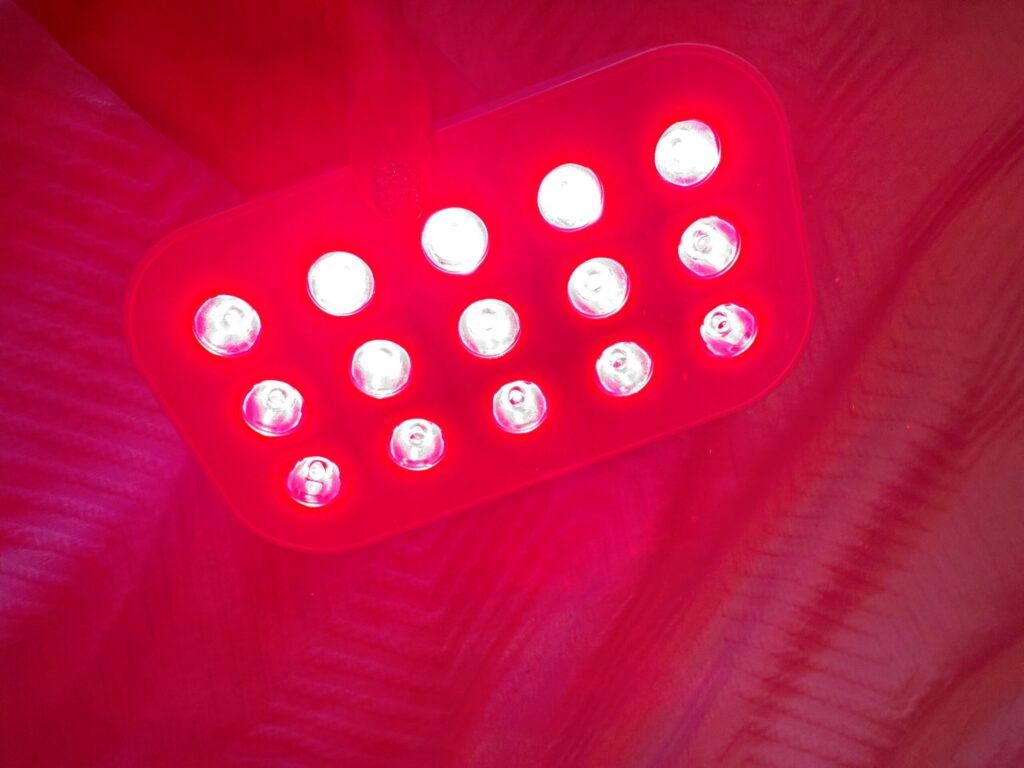
Red light therapy supports mitochondrial function and has solid research behind its effects on cortisol regulation and sleep quality. I use my Lumebox most mornings. It’s one of my favorite parts of my morning routine, and sometimes I’ll just prop it on my desk while I’m working. Morning red light exposure also helps anchor your circadian rhythm, which is directly tied to that healthy cortisol curve! Use FITNESSISTA for an amazing discount here.
PEMF Mat
PEMF (pulsed electromagnetic field therapy) is one of those things I was skeptical about until I tried it consistently. The research on PEMF and stress response is fascinatinhg – it works at a cellular level to support nervous system regulation, reduce inflammation, and improve sleep quality. I use mine in the evenings as a way to signal to my body that it’s time to downshift or I’ll use it in the morning for meditation. This is my favorite one and my code is FITNESSISTA
Where to Start If This Resonates
If you read through that symptom list and found yourself nodding along, here’s what I’d suggest:
Start with the basics. Before anything else: are you sleeping 7–9 hours, eating protein at every meal, managing your caffeine timing, and building in actual rest? These aren’t glamorous answers, but they move cortisol more than almost anything else.
Consider testing. You can’t really optimize what you can’t see. If you’re dealing with multiple symptoms and have been for a while, running the EquiLife Women’s Wellness Test will give you an actual picture of what your cortisol is doing throughout the day and we can go through the results together! Grab it here.
Look at your exercise. If you’re consistently doing high-intensity workouts and feeling more depleted than energized, this is worth reconsidering. Lower-intensity movement – walking, Pilates, yoga – is often much better for adrenal recovery than more HIIT. I LOVE Sculpt Society workouts. They give me an amazing burn but I don’t feel depleted afterwards.

Work on your wind-down. Whatever works for you and helps you feel calm and wind down. For me that’s a combination of red light glasses, putting the phone down earlier than I’d like to and swapping it for a book, the PEMF mat, and my CBD gummies on the nights that I’m feeling extra stressed or wired. Find what works for you and protect that time! I also love an Organifi Golden Milk with some warm almond milk.
Be patient with yourself. This is probably the most important one. Cortisol dysregulation usually develops over months or years. It doesn’t resolve in a week (unfortunately). The good news is that the pattern can absolutely shift, and when it does, you feel like a different person.
I genuinely wish someone had handed me this information years ago. Once you understand what’s driving your symptoms, you have so much more power to address them, instead of guessing with supplements and trying to push through.
If you have questions, drop them in the comments. If you want to run your labs and go over the results together, lmk – I’m here!
xo,
Gina
This post is for educational purposes and is not intended as medical advice. Always work with your healthcare provider for diagnosis and treatment.


